
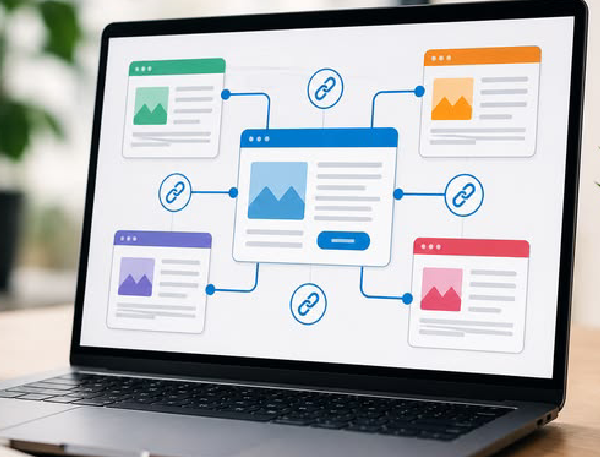
Internal links connect one page of a website to another page on the same website. They help visitors navigate content and help search engines discover and understand the relationship between different pages.
Table of Contents
ToggleFor businesses, a well-planned internal linking strategy can make important pages easier to find, improve website navigation and support search engine optimisation.
Understanding how internal links improve website SEO can help you organise your website content and create a better experience for visitors.
1. Help search engines discover your pages
Search engines use links to discover pages and understand how they connect. When you link from an existing page to a relevant new page, you can help search engines find that content.
For example, a web design company publishing an article about website maintenance could link to a separate page explaining its website maintenance services.
Make sure important pages are accessible through relevant links and that your website has a logical structure. Internal links can support discovery, although they do not guarantee that a page will be indexed.
2. Distribute link value across your website
Internal links can help distribute link equity, sometimes called link value, between pages on your website.
When an important page receives external links, relevant internal links can help search engines understand which other pages are connected to it.
For example, a business website may link from a popular blog post to a relevant service page. This creates a useful connection between informational content and the service being offered.
Link to pages that are genuinely relevant instead of adding links simply to increase their number.
3. Improve website navigation and user experience
Visitors should be able to find useful information without struggling to navigate your website.
Internal links help users move between related pages, explore additional information and find the services or products they need.
For example, a blog post about choosing a domain name could link to a relevant domain registration page. A reader who wants to register a domain can then find the service more easily.
Use descriptive anchor text so visitors understand what they can expect when they click a link.
4. Help search engines understand page relationships
Internal links provide context about how different pages relate to one another.
For example, a website offering web design, hosting and SEO services could organise its content around these topics. Relevant links between blog posts and service pages help establish connections between related information.
Use natural anchor text that describes the destination page. Avoid repeating the same keyword excessively or linking unrelated pages just to manipulate rankings.
A clear website structure makes it easier for visitors and search engines to understand your content.
5. Guide visitors towards important business pages
Internal links can help direct visitors from informational content to pages where they can take action.
For example, someone reading an article about improving website speed may also be interested in website maintenance or web development services.
Relevant links can guide that visitor to the next useful step, whether it is reading another article, viewing a service or contacting your business.
For best results, link to pages that match the reader’s needs and make sure the destination provides useful information.
How to create an effective internal linking strategy
To improve your internal linking, review your website regularly and identify opportunities to connect related pages.
Follow these practices:
Link to relevant pages that provide additional value.
Use clear, descriptive anchor text.
Link important service pages from relevant blog posts.
Check for broken internal links.
Avoid excessive links that distract readers.
Make sure important pages are not difficult to reach.
Update older articles with links to relevant new content.
You can also use tools such as Google Search Console to review your website’s indexing and search performance. Internal linking should support useful content and a logical site structure rather than replace other SEO work.
Common internal linking mistakes to avoid
Some internal linking practices can make a website harder to use or understand.
Avoid linking unrelated pages, using vague anchor text such as “click here” when a descriptive phrase would be clearer, and adding so many links that the content becomes difficult to read.
You should also check for broken links and avoid leaving important pages isolated from the rest of your website.
The goal is to make navigation natural for visitors while helping search engines discover relevant content.
How Kenya Website Designers can help
At Kenya Website Designers, we provide SEO services to help businesses improve their website structure, content and online visibility.
Our SEO services can include keyword research, on-page optimisation, technical SEO and content optimisation. We also offer website design, web development, web hosting, website maintenance and web content creation.
If your website has useful content but visitors struggle to find related services or important pages, improving its internal linking structure can be a practical step towards a better user experience and stronger SEO foundations.
